

Moving in Lower Saxony: parking restrictions by city from Hanover to Oldenburg
From Berlin to Lower Saxony
Seven major cities, one journey from Moabit
Fixed price upfront

Request a move in Lower Saxony
Book ahead, team from Berlin
Offer depends on availability, time frame and individual requirements on site.
PROFESSIONAL MOVING SERVICE
Professional moving solutions for Berlin and the surrounding area. Fast, safe and reliable.

Private move
Long-Distance Move
No-Parking Zone

Berlin team, Lower Saxony rules
Moving company from Berlin-Moabit for Lower Saxony
Checking each city's rules
Transparent fixed prices
Careful team
Flexible scheduling
Principles for moves in Lower Saxony
Reliability
Care
Fairness
Travelling from Berlin
Flexible support
Clear agreements
Part load between Berlin and Lower Saxony

Customer
review

Parking
restrictions, old towns, countryside: planning a move in Lower Saxony
Parking rules by city
Half-timbered old towns
Heath, Emsland, coast


Key answers for your move in Lower Saxony
Early enough to meet the city's deadlines: according to the city, Braunschweig requires the parking restriction application at least 3 weeks in advance, Osnabrück at least 10 days. Because we travel from Berlin, allow a little lead time.
Moves in Lower Saxony – with a team from Berlin-Moabit
Covering around 47,700 square kilometres, Lower Saxony is the second-largest German state after Bavaria and has around eight million inhabitants. Besides the state capital Hanover, there are six other major cities: Braunschweig, Oldenburg, Osnabrück, Wolfsburg, Göttingen and Salzgitter. Praktik Transport und Umzüge is not based in Lower Saxony but at Stromstraße 21 in Berlin-Moabit. For your move, the team travels out with the lorry – it is around 226 road kilometres to Wolfsburg and around 434 to Oldenburg.
For private households we offer the classic private move with packing, transport and furniture assembly, and for offices, practices and businesses the office move. We take into account what the address brings with it: half-timbered old towns such as Celle, period buildings in the big cities or farms in the countryside on the Lüneburg Heath and in the Emsland.
The route depends on the destination. Running through Lower Saxony are the A2 from the Ruhr area through the Hanover–Braunschweig area towards Berlin, the A7 from southern Germany to the coast, the A1 (Hansalinie) via Osnabrück and Bremen to Hamburg, and the A31 through the Emsland to Emden. We set out in the offer which route makes sense for your move.
Our aim is to make every move in Lower Saxony as stress-free as possible: with a fixed price after a survey and a schedule that takes into account the journey from Berlin and the rules of the destination city – whether a city flat in Hanover, a detached house in the Oldenburg area or a commercial unit in Wolfsburg.
Moving in Lower Saxony: major cities and regions at a glance
Lower Saxony stretches from the North Sea coast to the Harz and from the Ems to the Elbe. For a smooth move, what matters is which city or region is involved and which rules apply there. The cities for which we have dedicated pages include:
- Hanover – the state capital with around 523,000 inhabitants and the state's most important rail hub. Details under Hanover.
- Braunschweig – the second-largest city with around 253,000 inhabitants, around 231 km from our base. More under Braunschweig.
- Oldenburg – the third-largest city, a university city in the north-west with around 177,000 inhabitants. See Oldenburg.
- Osnabrück – around 166,000 inhabitants, on the A1 and the A30. Information on Osnabrück.
- Göttingen – a university city in the south with around 131,000 inhabitants. More under Göttingen.
- Wolfsburg and Salzgitter – industrial cities in the east, around 226 and 247 km from Stromstraße respectively. See Wolfsburg and Salzgitter.
On top of these come Hildesheim and Celle, as well as regions such as East Frisia, the Emsland, the Lüneburg Heath, the Weser Uplands and the Harz. Each of these regions has its own routes and access roads, which we take into account when planning the move.
Regional features of moving in Lower Saxony
A move in Lower Saxony differs considerably from region to region. In the major cities such as Hanover, Braunschweig or Osnabrück, parking and loading space are the main issue. A parking restriction zone often makes sense here so that the removal van can stand close to the door – each city sets its own application, deadline and fee.
In historic old towns such as Celle, whose half-timbered houses survived the Second World War undamaged, narrow streets, listed buildings and tight staircases make moving furniture harder. Here we discuss carrying routes and vehicle size during the survey.
Things look quite different in rural regions: on the Lüneburg Heath, in the Emsland or in East Frisia, villages lie further apart, farms have their own access roads and the journey from Berlin takes longer. We plan for this with enough time in reserve.
The Harz in the south-east is an upland range; its highest peak in Lower Saxony is the Wurmberg at 971 metres. Gradients and narrow roads play a role there for access and the choice of vehicle. On the coast there are also the East Frisian Islands, which can only be reached by ship or plane – we clarify such moves with you individually.
The area around Hanover, Braunschweig, Wolfsburg and Salzgitter is closely interlinked and, together with Göttingen, forms a shared metropolitan region; many moves here are connected with a new job. We take all these factors into account when scheduling, so that your move in Lower Saxony runs smoothly regardless of city or district.
Moving costs in Lower Saxony – prices as a guide
The cost of a move in Lower Saxony depends on several factors: the size of the flat, distance, floor, accessibility and any additional services required, such as packing or furniture assembly. So that you can budget early, we give you a realistic guide value.
| Flat size | Approximate price |
|---|---|
| 1-room flat | from €344 |
| 2-room flat | from €615 |
| 3-room flat | from €884 |
| Long-distance move (per kilometre) | from €4.15/km |
| Parking restriction zone (per day) | €30–100 |
These prices are a guide and may vary depending on the individual scope. A move within Hanover, for example, costs less because of the short distance than a move from Oldenburg to Göttingen, where a much longer route has to be covered.
Additional costs may arise from special services, such as delicate piano transport, professional clearance of the old flat or organising a parking restriction zone in densely built city centres such as Hanover or Braunschweig.
We recommend obtaining a personal offer before the move, as we take factors such as the number of boxes, floors without a lift or special items into account individually. This way you avoid unpleasant surprises and get a realistic picture of the total cost of your move in Lower Saxony from the start – whether within one city or over long distances between the coast and the Harz.
From Berlin to Lower Saxony – distances and planning
By area, Lower Saxony is the second-largest state in Germany, so moves vary greatly in distance and effort. We distinguish between moves within a city or region and moves over long distances, for example between Berlin and Lower Saxony or right across the state.
Because our base is in Berlin-Moabit, the journey is always part of the planning. The following road distances apply from Stromstraße 21:
| Route | Road kilometres |
|---|---|
| Berlin – Wolfsburg | approx. 226 km |
| Berlin – Braunschweig | approx. 231 km |
| Berlin – Celle | approx. 275 km |
| Berlin – Hanover | approx. 285 km |
| Berlin – Göttingen | approx. 335 km |
| Berlin – Osnabrück | approx. 419 km |
| Berlin – Oldenburg | approx. 434 km |
For long-distance moves our price list starts at €4.15 per km, plus the effort for loading and unloading; the fixed price after a survey is binding. For smaller volumes we also offer an affordable part load, where your goods are transported together with other consignments.
Regardless of distance, we plan the time realistically: on long routes we allow for breaks and a buffer for traffic on the A2 or A7, while on short routes within a city the focus is on parking space and carrying routes. This keeps your move in Lower Saxony – near or far – predictable and easy to budget.
Our services for your move in Lower Saxony
For moves in Lower Saxony, Praktik Transport und Umzüge offers the full range of services for home and office moves. Depending on your needs, we put together a suitable package of services:
- Private move – a complete service from packing to assembling furniture in the new flat, whether in Hanover, Oldenburg or Göttingen.
- Office move – relocation of offices, practices and businesses with as little downtime as possible, for example in Braunschweig or Wolfsburg.
- Part load – affordable transport of smaller volumes over long distances, ideal for students or individuals.
- Clearance – clearing cellars, attics or entire houses, for example when dissolving a household in the countryside.
- Parking restriction zone – planning the loading space according to the rules of the city concerned, for example in Hanover, Braunschweig or Osnabrück.
- Piano transport – safe transport of upright and grand pianos with suitable equipment.
- Senior move – a move that takes special needs into account, for example when moving into assisted living.
- Student move – affordable solutions for students in university towns such as Göttingen, Oldenburg or Osnabrück.
In addition, we offer packing materials, assembly and dismantling services and, on request, furniture storage. This way you get all services for your move in Lower Saxony from a single source – combined individually according to scope and budget.
How your move in Lower Saxony works – step by step
So that your move in Lower Saxony is structured and predictable, we at Praktik Transport und Umzüge follow a fixed procedure. It can be adapted flexibly to regional conditions – whether a city-centre location in Hanover or a rural property on the Lüneburg Heath.
- First contact and enquiry: You describe your plans – starting point, destination, the goods to be moved and your preferred date.
- Survey and offer: If required, we view your flat on site or virtually to assess volume and effort realistically and draw up a transparent fixed-price offer.
- Planning the logistics: We check access routes, the parking situation and, where applicable, the need for a parking restriction zone, especially in narrow half-timbered old towns such as Celle.
- Packing: On request, we take care of properly packing your household goods, including high-quality packing material.
- Transport day: Our team loads your goods safely, transports them on the most suitable route – for example via the A2, A7 or A1 – and delivers them to the destination on schedule.
- Assembly and setting up: Furniture is assembled and placed as you wish, so you can settle in straight away.
- Follow-up: We remain available after the move for questions or remaining tasks.
This clear procedure applies equally to small flat moves in Hildesheim and to office moves in Wolfsburg. This way you keep track of dates, costs and responsibilities at all times – from the first enquiry to the final touch in your new home in Lower Saxony.
What a Berlin moving company does in Lower Saxony
Lower Saxony is diverse: major cities such as Hanover and Braunschweig, university towns such as Göttingen and Oldenburg, industrial locations such as Wolfsburg and Salzgitter, plus the coast, the heath and the Harz. We are open about where we stand: Praktik Transport und Umzüge is a moving company from Berlin (Stromstraße 21, Moabit), not a Lower Saxony business with branches.
What we bring is thorough preparation. Before every date we clarify what the destination city requires – for example, that Braunschweig, according to the city, expects the parking restriction application at least three weeks in advance and that the applicant puts up the signs, or that Osnabrück, according to its service portal, only sets up parking restrictions for loading activities. These rules feed into every move plan.
We also value transparent pricing with a fixed price after a survey, careful staff and vehicles of the right size for narrow city centres and rural access roads. Jobs range from small student moves in Göttingen to office moves in Hanover.
Another point is the route itself: anyone moving from Berlin to Lower Saxony or the other way round benefits from the fact that our lorry starts in Berlin anyway. Anyone moving within Lower Saxony, for example from Osnabrück to Braunschweig, receives a realistic estimate of driving time and journey from us.
Last but not least, we value personal support: one contact person answers your questions and makes sure that all agreements are kept. This turns your move in Lower Saxony – regardless of city, district or distance – into a well-organised project with predictable costs.
Parking restrictions in Lower Saxony: Hanover, Braunschweig and Osnabrück
In Lower Saxony, too, the local city decides how you get a parking restriction for your move. Three examples, according to the city websites:
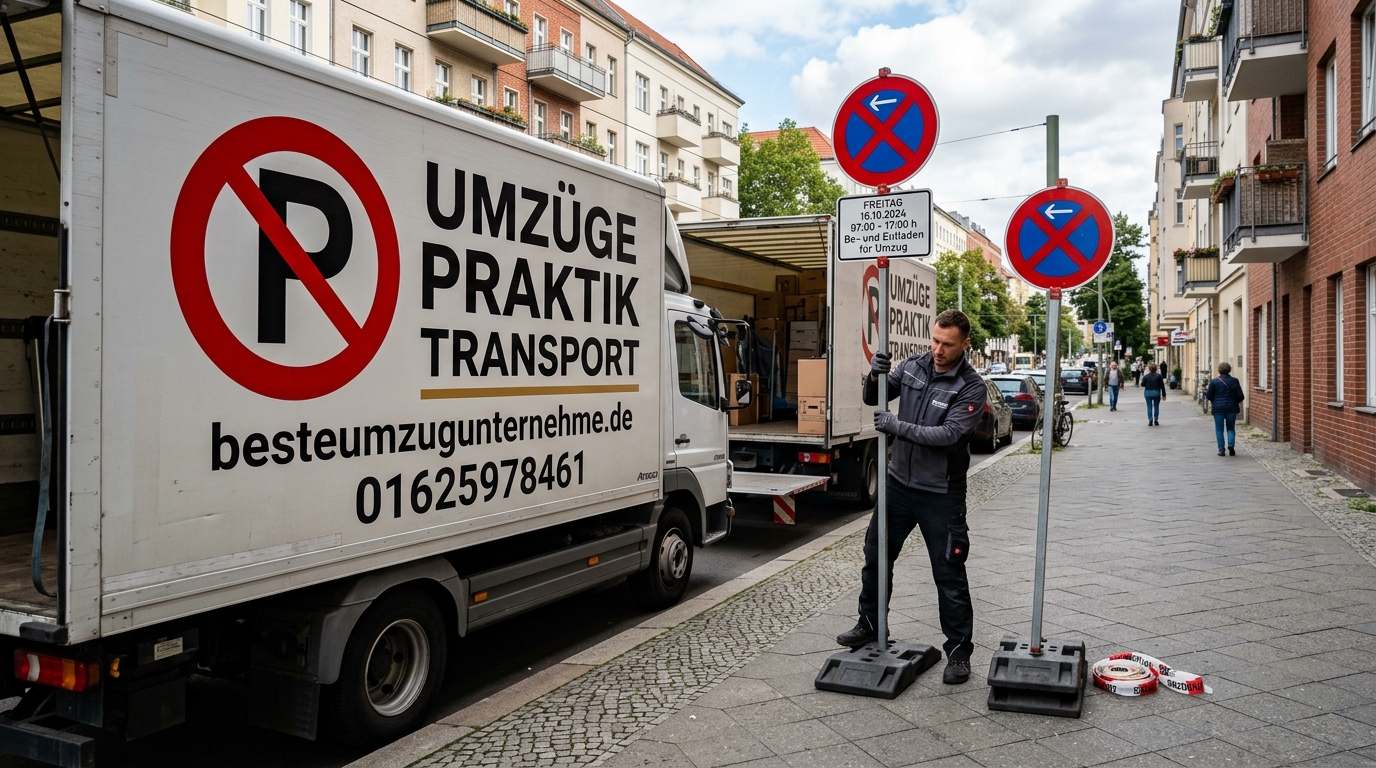
- Hanover: The road traffic authority of the state capital issues the permit. Apply online or by appointment at the Bürgerservice Bauen. The application should be made two weeks in advance if possible, and no later than 8 working days beforehand. The signs must be up at least 3 full calendar days before the restriction; the city runs the sign rental at Burgweg.
- Braunschweig: The road traffic department (Abteilung Straßenverkehr) needs the application at least 3 weeks in advance, online or by post. According to the city, the daily fee is €25; you put up the signs yourself, at least 4 days before the move.
- Osnabrück: The traffic management department (Verkehrslenkung) is responsible. The application should be made at least 10 days before the date and, according to the service portal, costs €30; you organise the signs yourself.
It is better to plan generously, as deadlines and fees can change. You can read more about these places on our pages on Hanover, Braunschweig and Osnabrück. You will find our service under parking restriction zone.
Note the differences in detail: Osnabrück generally only grants parking restrictions for loading activities, not for reserving parking spaces. In Braunschweig's pedestrian zone no permit is needed within the delivery hours (6 pm to 11 am), while between 11 am and 6 pm an exemption permit is required.
Moving in Lower Saxony: cities, Harz, heath and coast
According to the state portal, Lower Saxony stretches from the Ems to the Elbe and from the uplands in the south to the North Sea coast. Each landscape presents a move with different tasks.
- Cities: According to the state portal, Hildesheim, Salzgitter, Hanover, Wolfsburg and Braunschweig lie north of the Harz; it also names Osnabrück, Oldenburg and Göttingen. Here, parking and access matter most.
- Harz: The upland range is known for its half-timbered towns. Narrow lanes and gradients call for a survey in advance.
- Lüneburg Heath: The quiet heathland is named after Lüneburg. In the countryside distances are often longer, so we plan the journey precisely.
- Coast: According to the state portal, the coast also includes the seven East Frisian Islands.
After moving in, you register with the registration office within two weeks (§ 17 Bundesmeldegesetz). The journey always starts at our base at Stromstraße 21 in Berlin-Moabit, and the route is measured in the offer. For nearby cities, take a look at Göttingen, Oldenburg and the neighbouring states of Saxony-Anhalt and Hamburg. General information is available on our long-distance move page.
For the Harz, the state portal mentions former silver mines; for the Lüneburg Heath, the town of Lüneburg, which grew wealthy from salt in the Middle Ages; and for the coast, Wilhelmshaven as the state's largest port.